

Agriculture in India is at an inflection point.
Rising input costs, shrinking labour availability, and growing pressure to improve yields while protecting natural resources push farmers toward smarter tools.
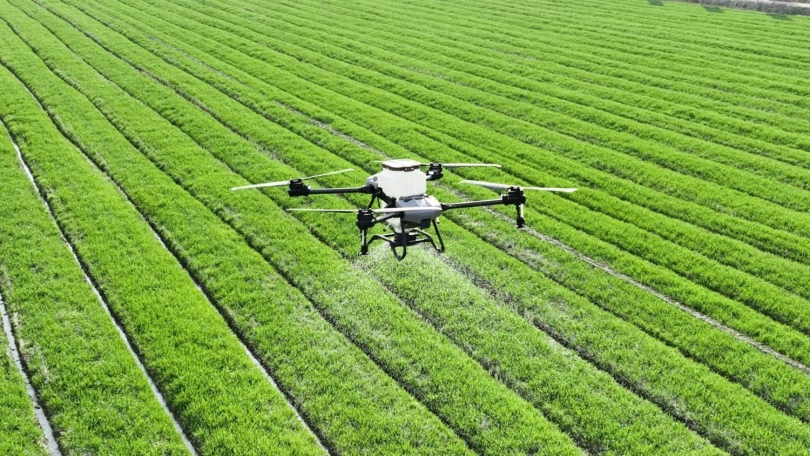
Enter Leher, an ag-tech platform bringing drone-spray services and precision farming to fields across the country.
By combining local operator networks with spray drones, Leher is making advanced, sustainable crop protection practical and affordable for small and medium farms.
Why Drones Matter Now
Drones are not a futuristic luxury for big agribusiness alone. They are a pragmatic response to real, present problems: uneven pesticide application from manual sprayers, mounting labour shortages for time-sensitive tasks, and wasteful water use in spray operations.
Leher positions itself at the intersection of these needs, offering on-demand drone spraying through trained local partners so farmers get fast, accurate coverage without owning expensive equipment.
The Commercial Case For Drones
The macro picture supports drone adoption.
Analysts and financial writers report that the commercial drone market is large and growing as enterprises deploy drones for mapping, inspection, and spraying, evidence that investment and innovation in drone tech are accelerating.
One overview noted the commercial drone market’s substantial size and highlighted its growing relevance across sectors.
What Leher Does Differently
Leher’s model is simple but powerful: the company provides the technology, training, scheduling, and logistics; local entrepreneurs operate drones; farmers book services on a per-field basis.
This platform approach removes ownership barriers and turns drones into a pay-per-use utility for agriculture.
Key elements of Leher’s approach include:
- Local Operator Network: Leher recruits and trains rural partners to run spray missions, creating livelihoods while ensuring timely service.
- Turnkey Service: From flight planning to safety checks and spraying, the Leher team manages operations so farmers receive consistent, reliable results.
- Technology Fit: Leher deploys multirotor sprayer drones with GPS guidance and flow-regulated nozzles to improve dose accuracy and reduce overlaps.
Tangible Farmer Benefits
The proof is in field results. Leher reports that drone spraying can save up to 90% water compared with some traditional spray methods and can reduce farming costs by 20–30% in certain operations.
Those figures show how efficient aerial application can drastically cut waste while maintaining or improving coverage.
Those savings have three practical effects:
- Lower Variable Costs: Reduced pesticide and water use directly improves margins, especially for smallholders working tight budgets.
- Faster Turnaround: A single drone can cover multiple acres in a day, which matters when treatment windows are short.
- Safer Work: Drones keep operators away from chemical exposure and minimize drift to neighbouring fields.
Operational Realities And Challenges
Drones are powerful tools, but they come with limits.
Flight time and payload size restrict how much area a single sortie can cover; battery charging and spares must be managed; weather can ground operations; and farmers need assurance that drone application is both safe and effective.
For Leher, scaling beyond pilot clusters means robust logistics, strict quality control, and continuous operator training.
Converting trials into routine practice also depends on trust.
Farmers accustomed to manual spray crews need clear demonstrations of efficacy and cost advantages.
Leher’s local operator model helps here, the same community that books services can also vouch for their quality.
Customer testimonials and on-farm demos remain essential for wider uptake.
Policy And Market Tailwinds
Government policy and market forces are tilting in favour of precision agriculture.
Regulatory clarity on drone operations, subsidised training schemes, and rising farm technology investments make it easier for platforms such as Leher to expand.
At the same time, commercial drone applications are becoming mainstream across sectors, a signal that capital and talent are moving into drone tech.
This policy and market momentum matter because they reduce friction: subsidies cut the effective price of drone services or equipment; regulatory clarity speeds operator certification; and growing market investment brings better hardware and economies of scale.
Beyond Spraying: The Next Phase For Leher
Spraying is an immediate, high-impact use of drones but it’s only the first step.
The real long-term value lies in data and integrated services.
If Leher combines high-resolution imagery with analytics, the platform can provide plant-health maps, early pest warnings, and prescription recommendations.
That turns Leher from a spray service into a full precision-farm advisor offering actionable insights that improve yields and input decisions.
Potential add-ons include:
- Crop Health Monitoring: Regular drone flights to track stress, nutrient deficiency, or disease early.
- Prescription Application: Variable-rate spraying and fertiliser application based on field patches that need treatment.
- Input Partnerships: Integrated offerings with seed, fertiliser and crop protection firms to bundle advisory and inputs with drone application.
These services increase farmer ROI by making inputs more targeted and timely and they create stronger revenue streams for the platform.
Environmental And Social Impact
The environmental benefits of precise aerial application are clear. Lower pesticide volumes and reduced water use shrink the ecological footprint of crop protection.
Reduced drift and more accurate dosing also help maintain soil health and protect beneficial insects.
Socially, Leher’s model promotes rural entrepreneurship by turning drone operation into a viable local business.
Trained operators earn income while providing a crucial service to fellow farmers, which supports rural livelihoods and spreads technology benefits more equitably than large-scale hardware sales alone.
What Needs To Happen For Scale
For Leher to move from promising pilots to mass adoption, several factors must align:
- Operator Capacity: Ongoing training and support so operators maintain consistent application standards.
- Supply Chain: Readily available spare parts, batteries and service hubs across regions.
- Farmer Education: Demonstrations and transparent cost-benefit communication to build trust.
- Policy Support: Continued regulatory clarity and incentives to make drone services affordable.
When these elements align, the platform model becomes a scalable pathway to deliver precision agriculture across fragmented landholdings.
Conclusion
Leher is turning drone technology into a practical, on-demand tool for India’s farmers.
By combining local operator networks, reliable drone hardware, and platform logistics, Leher addresses both technical and economic barriers to precision spraying.
The company’s reported savings such as major reductions in water use and 20–30% lower spraying costs in some operations, point to real on-farm impact.
Coupled with strong market momentum for commercial drones and a clearer regulatory environment, Leher’s approach could become a mainstream solution for sustainable, efficient crop protection.
For farmers, input partners, and investors seeking to improve productivity while cutting waste, Leher represents a concrete step toward modern, resilient agriculture.