

Most companies obsess over the shipping box and barely think about what goes inside it. That is backwards. The outer carton is a container. The interior packaging is what actually stops the product from breaking, and when a shipment arrives damaged, the failure is almost never the box itself. It is the empty space inside it.
Interior packaging is the category that covers partitions, pads, dividers, layer sheets and die cut inserts. These are the paper based components that hold individual units apart so they cannot strike each other during handling and transit. For anyone shipping glass, ceramics, machined parts, electronics or anything with an edge that can chip, this is the part of the package that does the protective work.
Two materials dominate the category: solid fiber and corrugated. They are not interchangeable, and choosing the wrong one is an expensive mistake that usually shows up as a damage claim three months later.
What solid fiber actually is
Solid fiber board is made of laminated plies of paperboard pressed into a dense, flat sheet. There is no fluting, no air layer, just compressed material. That gives it two practical advantages.
The first is cost. Solid fiber generally carries a lower unit cost than corrugated for the same application, which matters when you are buying millions of cells a year.
The second is storage. Because there is no flute to hold air, solid fiber takes up dramatically less warehouse space than an equivalent corrugated product. Manufacturers who convert both materials report that solid fiber can occupy up to 80 percent less space in a facility. If your receiving dock is tight or you buy in long runs to hold a price, that difference is not trivial. It is the difference between one pallet position and five.
Solid fiber also converts without tooling in many cases. A supplier running adjustable dies can change strip width and cell size across a wide range without charging you for a new die. For a company that runs many SKUs in small volumes, avoiding tooling charges on every configuration change is often the whole argument. Suppliers who specialize in solid fiber partitions tend to service both very high and very low volume runs for exactly this reason.
Where solid fiber falls short is compression. It is dense but it does not cushion. It holds position. It does not absorb shock.
What corrugated actually is
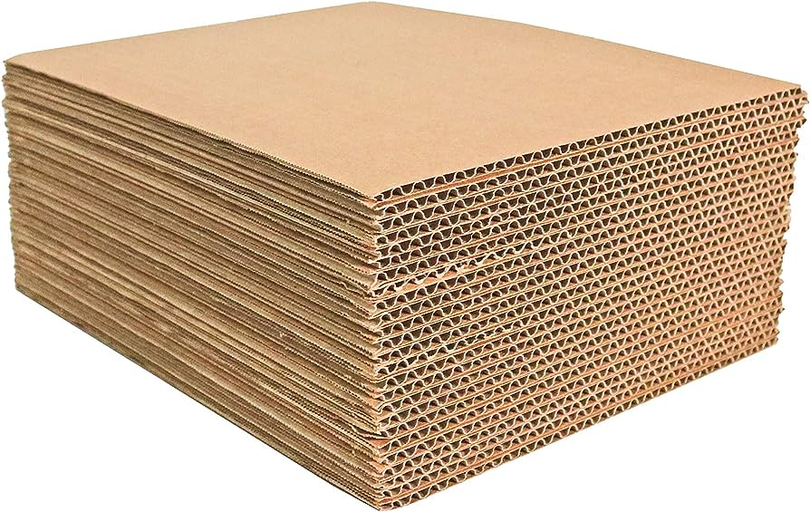
Corrugated fiberboard is a fluted medium glued between one or two liners. That flute is the entire point. It is a row of engineered arches, and it does two things solid fiber cannot.
It carries vertical load. Stacking strength is the single most requested property in a carton, and corrugated fiberboard delivers more of it than solid fiber at comparable weight. If your product stacks three pallets high in a warehouse or gets loaded to the ceiling of a trailer, the interior components are carrying part of that load whether you designed for it or not.
It also cushions. The flute compresses and recovers, which absorbs impact energy instead of transmitting it into the product. That same structure resists scuffing, so the surface of whatever you are shipping arrives without abrasion marks.
The tradeoff is bulk and cost. Corrugated takes up more space and generally prices higher per unit.
How to actually make the call
Strip the decision down to five questions.
- How heavy is the unit? Heavier products load the partition in compression. That pushes toward corrugated.
- How fragile is the surface? Glass, coated metal, painted parts and polished ceramics scuff. Corrugated protects the finish better.
- How high does it stack? High stacking is a compression problem. Corrugated.
- How much storage space do you have? If you are space constrained or buying in long runs, solid fiber wins on footprint and often on price.
- How many configurations do you run? Frequent changeovers favor a material and a supplier that avoid tooling charges.
Most real operations end up with both. A company shipping glass bottles might use corrugated partitions for the twelve pack export configuration and solid fiber for a lighter domestic six pack. The right answer is usually a mix, which is why it pays to source from a converter that makes both rather than one that only sells you what it happens to run.
The glass and beverage case
Glass is the hardest test. A bottle is heavy, brittle, round and it stacks. It also travels through more touches than almost any other product category, moving through fillers, distributors, warehouses and often a parcel network at the end.
For glass, cell geometry matters as much as material. The cell has to match the bottle diameter closely. Too tight and you cannot load the case efficiently. Too loose and the bottle moves, and movement is what breaks glass. Every millimeter of slack is energy waiting to transfer into the shoulder of the bottle.
This is why the spec conversation with a supplier should start with the product, not the material. A good converter will ask for the bottle dimensions, the case count, the stacking plan and the freight lane before quoting anything.
- Ask about cell and strip range, because that determines whether your configurations fit existing dies.
- Ask about tooling. Some products require a die and some do not, and a supplier who is straight with you about that is worth keeping.
- Ask about volume floors. Some converters only want long runs. Others service the full range, from a few thousand to millions.
- Ask about facility location. Interior packaging is bulky and freight is a real line item. A corrugated partition manufacturer with more than one plant can serve a wider geography without the freight cost eating the savings on the part itself.
- Ask about lead time and sample turnaround. Getting a physical sample into your packaging engineer’s hands early is worth far more than another round of drawings.
The part everyone gets wrong
Interior packaging is specified last, usually after the box is already locked in and the budget is set. By then the only variable left is price, so the cheapest insert wins, and the damage rate quietly climbs.
Spec the inside first. Decide how the product needs to be held, choose the material that holds it that way, then build the carton around it. Paper based partitions and pads are recyclable, curbside friendly and a straightforward replacement for foam and expanded polystyrene, so the sustainability question usually answers itself once the protection question is settled.
Damage claims are expensive. Partitions are not.