
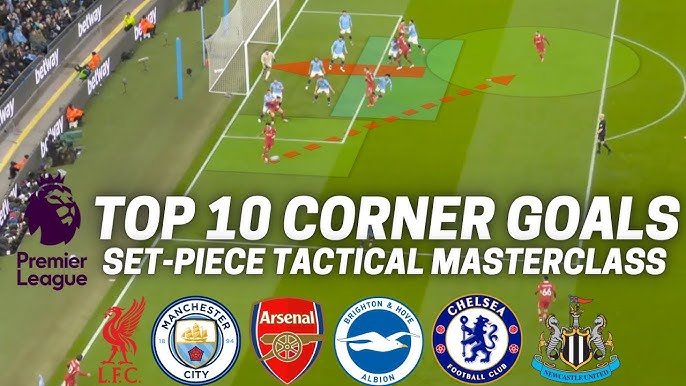

Corner markets depend less on goals and more on territorial pressure, shooting volume, and attacking patterns, so they often follow different logic from traditional 1X2 or goal-based bets. In the 2023/24 Premier League season, some teams repeatedly produced matches with high corner totals, while others generated slower, low-corner games, and that divergence created distinct profiles for over and under strategies. Understanding the mechanisms behind those patterns matters more than memorising lists, because the causes—tactics, shot choices, and game state—determine whether the trend is likely to continue.
Why Corner Totals Deserve Their Own Analysis
Corners capture how often a team forces the ball into the final third and into blocked or deflected shots, so they reflect attacking pressure even when scorelines stay tight. A side that takes many shots from wide or half-spaces, pushes full-backs high, and spends long stretches in the opposition half usually racks up more corners over a season. In contrast, teams that attack through slower central combinations or rely on a small number of high-quality chances may create fewer corners despite being efficient in front of goal.
For over/under corner betting, this distinction matters because total corners can remain high even in matches with few goals, especially when one side dominates territory but struggles to finish. Conversely, a clinical team that scores early and then controls the game with low-risk passing may see corner counts drop sharply once the result feels secure. Treating corners as their own statistical world avoids the common mistake of assuming “more goals equals more corners”.
Which Teams Generated High Corner Volumes in 2023/24?
In 2023/24, Liverpool won more corners than any other Premier League team, finishing the season with 287, narrowly ahead of Manchester City on 286 and Arsenal on 265. These clubs combined aggressive attacking structures with sustained territorial dominance, which naturally translated into frequent deflected shots and blocked crosses. Behind this front three, Bournemouth’s appearance near the top of corners-won tables highlighted how a more direct, crossing-heavy style can also drive corner counts even without elite attacking talent.
Premier League 2023/24 – High-Corner Teams (Overall Corners Won)
| Team | Corners won (league) | Corner profile 2023/24 |
| Liverpool | 287 corners | Relentless attacking pressure, many shots and crosses |
| Manchester City | 286 corners | Sustained possession in final third, high shot volume |
| Arsenal | 265 corners | Structured attacks with frequent wide deliveries |
| Bournemouth | Around mid-200s, 4th in corners table | Direct style forcing blocks and deflections |
For over-corner markets, these teams offered clear cause–effect logic: dominant field position and high shooting rates pushed corner totals upward even when matches were relatively controlled. However, backing overs blindly would ignore context, because their ability to keep pressing for corners varied with scoreline, opponent, and fixture congestion.
Teams and Situations That Favoured Lower Corner Totals
At the opposite end of the spectrum, sides that defended deep, allowed the opposition to shoot from better positions, or relied on counter-attacks often produced fewer corners overall. League-wide corner tables show that some lower-ranked teams generated modest totals for and against, reflecting low-possession games where transitions happened in open space rather than in crowded penalty areas. In those fixtures, shots either ended up on target or missed without touching a defender, which suppressed corner counts despite the possibility of goals.
For under-corner bets, these low-tempo, low-block matches are important, because both teams’ styles combine to reduce the number of blocked attempts. When a conservative side faces a technically superior opponent that prefers high-quality central chances over speculative crossing, the dynamic often moves toward controlled, low-corner games rather than all-out siege. The pattern fails mainly when the underdog is forced to defend constant waves of wide attacks, turning clearances and blocks into a sudden flood of corners.
Interpreting Corners Per Match, Not Just Totals
Raw totals can hide meaningful differences between teams with similar season-long corner counts, so corners per match and “for/against” splits add crucial nuance. Metrics that show how many corners a team wins and concedes per game, and the sum of both, help identify not only dominant attacking sides but also fixtures where both clubs contribute to the total. For example, corner-per-match tables have highlighted teams with games averaging around nine or more corners combined, versus others near the bottom where totals often stay under eight.
A practical way to use this is to track three numbers for each club: corners for, corners against, and combined match average. High “for” but low “against” suggests matches where one side does most of the corner production, whereas high values on both sides indicate end-to-end patterns suitable for higher lines. This distinction also affects live strategies, because a team that rarely concedes corners may keep totals suppressed even when chasing a deficit.
Mechanisms Behind High- and Low-Corner Teams
How playing styles turn into corner patterns
From a tactical angle, teams that shoot often from the edges of the box, rely on crosses, and attack repeatedly down the flanks tend to drive up corners because defenders have more opportunities to block or deflect attempts behind. Liverpool and Manchester City’s 2023/24 corner dominance reflected a blend of overlapping full-backs, aggressive wide forwards, and sustained recycling of possession around the penalty area, which forced defenders into emergency clearances. In contrast, sides that focus on through balls and cutbacks from more central positions may generate fewer corners even with similar xG, as more shots either hit the target or miss cleanly.
Defensive behaviour matters as well. Teams that block crosses early or force opponents to shoot from distance without closing aggressively can inadvertently reduce corner counts by turning attacks into straightforward saves or off-target shots. Meanwhile, teams that defend close to their own goal and throw bodies in front of everything can push corner numbers upward because almost every attack ends with a desperate block. Understanding these mechanisms allows bettors to anticipate corner patterns from tactical matchups rather than relying only on historical averages.
Data-Driven Betting Lens for Over/Under Corners
This article follows a data-driven betting approach, focusing on how to interpret corner information for structured decision-making. A sensible process starts with season-long stats: identify teams near the top of corners-won tables (Liverpool, Manchester City, Arsenal, Bournemouth) and those consistently involved in high- or low-total corner games. Then, for each upcoming fixture, compare both teams’ “corners for” and “corners against” per match to estimate a likely range before looking at the betting line.
If both teams contribute to high averages, an over becomes statistically more credible, provided the bookmaker’s line has not fully priced that in. If one side is a corner machine but the other rarely concedes corners, the expected total may sit closer to the dominant team’s usual output rather than to an explosive combined figure. Conversely, when two low-corner teams meet, the default expectation should tilt toward unders unless there is strong tactical evidence of a different pattern, such as a new coach pushing for wide, high-volume attacks.
Interaction Between Corner Data and a Sports Betting Service (UFABET)
The way a bettor encounters corner statistics can significantly shape how thoughtfully they use that information. Many users now view corner lines, historical averages, and live updates through integrated sports-focused environments that stack multiple leagues and markets into a single dashboard. Within that kind of structure, a person accessing over/under corner options through ufabet168 member might see Liverpool’s 287 corners or Bournemouth’s high ranking and feel an immediate pull toward overs, yet the critical step is slowing down to check opponent numbers, recent tactical shifts, and match context so that decisions come from genuine analysis of 2023/24 patterns rather than from the convenience of one-click presentation on the screen.
How “Most Corners Won” and “Goals from Corners” Diverge
An important nuance for anyone analysing corner data is the difference between winning corners and turning them into goals. Arsenal, for example, have stood out since 2023/24 for scoring more goals from corners than any other Premier League club, yet they did not top the corners-won table, finishing behind Liverpool and Manchester City. This gap shows that efficiency and volume operate on separate tracks: a team can generate many corners but create relatively few chances from them, while another can score frequently from a smaller number.
For over/under corner markets, only the volume matters directly, not the conversion rate. A match heavy on corners but light on goals can still cash corner overs and goal unders simultaneously, which is why set-piece efficiency should not be confused with corner intensity. Recognising this separation prevents misreading an attacking set-piece reputation as an automatic signal for high corner counts.
Corner Markets Within a Broader casino online Context
In wider digital gambling ecosystems, corner markets often sit next to goal, card, and non-football options, which subtly alters how users perceive them. Rapid-fire games and slots encourage very short feedback loops, and that rhythm can bleed into football decisions if bettors do not consciously slow down. When those same individuals move between different sections of a casino online environment, there is a risk that over/under corners are treated as just another quick-flip outcome rather than as a market grounded in tactical and statistical reasoning; the more disciplined approach is to pause, re-check corner-per-match data and stylistic matchups, and only then decide whether any corner line genuinely aligns with Premier League 2023/24 evidence.
Summary
Premier League 2023/24 corner statistics revealed clear high-volume teams—most notably Liverpool, Manchester City, Arsenal and Bournemouth—whose attacking pressure made them natural candidates for higher corner lines in the right fixtures. At the same time, low-corner sides and conservative matchups created realistic conditions for unders when both styles suppressed blocked shots and deflected crosses. For anyone thinking about over/under corner betting, the most robust edge comes from linking playing style, corners-for and corners-against data, and match context, turning raw numbers into reasoned expectations rather than simple reactions to headline totals.