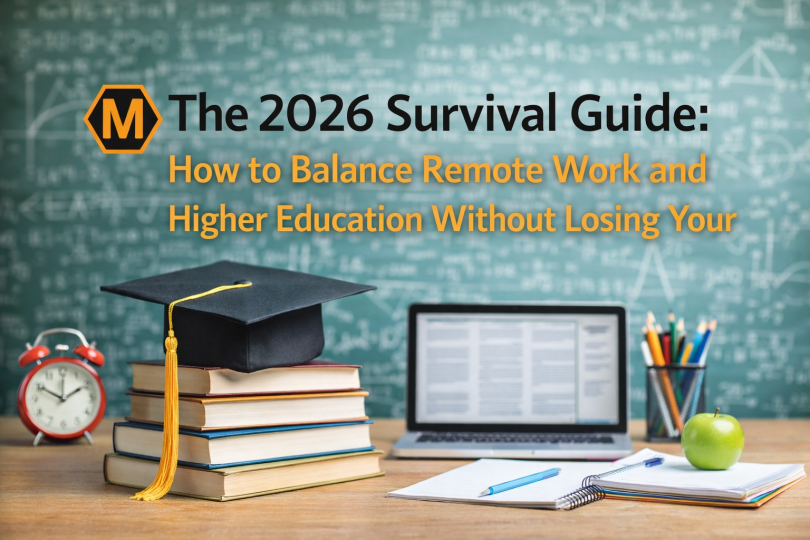

Let’s be real: the “college experience” advertised in brochures—lounging on a quad with a textbook—is a myth for most of us in 2026. Today, the average US student is a “slashie”: a student/freelancer, a student/remote-assistant, or a student/full-time-employee.
According to 2025-2026 data from the National Center for Education Statistics (NCES), over 70% of full-time undergraduate students are now balancing jobs alongside their degree. While the remote work revolution has made it physically possible to attend a lecture at 10:00 AM and a Scrum meeting at 11:00 AM, the mental toll is staggering. A recent Healthy Minds Network survey revealed that 61% of students meet the criteria for at least one mental health problem, primarily driven by “time-poverty.”
When you are staring at a blinking cursor at 2:00 AM with a 9:00 AM work deadline looming, the pressure is immense. It’s during these “crunch weeks” that high-achieving students pivot from burnout to strategy. Learning when to delegate—such as finding a professional to write my essay for me—is often the difference between a mid-semester breakdown and graduating with honors. It’s about managing your most limited resource: your sanity.
The “Time-Poverty” Crisis: Why You Need a Tech Stack
In 2026, the cost of living in the US has made working while studying a necessity, not a choice. However, the human brain isn’t wired for “context switching.” Every time you flip from a work email to a research paper, you lose 20% of your cognitive capacity.
To combat this, you need a “Productivity Architecture.” Here are the five tech tools that top-performing “worker-students” are using this year to stay ahead.
1. Notion: Your Digital Headquarters
Forget fragmented notebooks. In 2026, Notion is the gold standard for “Second Brain” architecture.
- The Student Use Case: Build a “Master Syllabus” database. Tag every assignment with its “Weight” (percentage of grade) and “Energy Level Required.”
- The Strategy: When you have a low-energy afternoon at work, tackle the “Easy” school tasks. Save the “Heavy Lift” academic research for your peak brain hours.
2. Clockify: Identifying Your “Efficiency Leaks”
Most students think they are “studying” for five hours, but they are actually scrolling TikTok for three of them.
- The Data: ZipDo’s 2025 Workplace report found that employees in remote roles are 20% more productive when using time-tracking software.
- The Student Hack: Use the Pomodoro timer in Clockify. Track your “Billable Hours” (Work) vs. “GPA Hours” (School). If you find your GPA hours are consistently low because of work overruns, it’s time to re-evaluate your delegation strategy.
3. Zapier: The Admin Assistant You Can’t Afford
Administrative “sludge”—uploading files, checking Canvas notifications, and updating calendars—takes up roughly 5-8 hours a week.
- The Setup: Create a Zap that sends your Canvas “Assignment Created” notification directly to your Slack.
- Why It Works: It keeps your academic life visible in your professional environment, preventing “deadline blindness.” This automation is a lifesaver when you decide to Pay for Essays Online during finals week; you can automate the delivery and tracking of your orders so nothing slips through the cracks.
4. Obsidian: For “Deep Research” Connections
While Notion is great for organization, Obsidian is for thinking. It uses a “Knowledge Graph” to link ideas.
- The Advantage: In 2026, professors are increasingly using AI-detection tools that look for “generic” writing. By using Obsidian to link your work experience with your academic theories, you create a “uniquely human” perspective that AI cannot replicate.
5. Focus@Will: The Neuroscience of Sound
Standard music often distracts. Focus@Will uses “Phase-Sequenced” music to put your brain into a flow state within 20 minutes.
- The Science: According to 2026 Neurological Studies, specific BPMs (Beats Per Minute) can increase “Time on Task” by 400%. This is essential when you have exactly one hour between your shift and your seminar.
Statistical Insights: The US Student Landscape (2026)
| The Student Struggle | Statistical Reality | Source |
| Students working 30+ hours/week | 44% | NCES (2026 Projection) |
| Experience of “Severe Burnout” | 81% | Codegnan Research |
| Preference for Asynchronous Learning | 89% | Educause 2025 |
| Use of Academic Support Services | 1 in 4 Students | US Education Audit 2026 |
3 Rules for Protecting Your Mental Health
Technology is only half the battle. To rank among the top students (and in the SERPs), you need a mindset shift.
I. The “No-Zero” Day
Never end a day without doing something for both your career and your degree. Even if it’s just reading one abstract or sending one professional email. This prevents the “mountain” of work from becoming psychologically paralyzing.
II. Radical Delegation
The most successful CEOs don’t do everything themselves. Why should a student? If a core-curriculum class (that has nothing to do with your future career) is taking 20 hours a week, delegate the writing. This allows you to focus on your “Major” and your “Promotion.”
III. The “Digital Sunset”
In 2026, the blue light from remote work is a health crisis. Set a “Digital Sunset” at 9:00 PM. No screens. Read a physical book or prep your meals. Research from Harvard (2025) shows that students with a set “Off-Switch” perform 15% better on cognitive tests than those who work until they fall asleep.
Frequently Asked Questions (FAQs)
Q: How do I manage a 9-to-5 job with a full-time course load?
A: You don’t “manage” it; you integrate it. Use your lunch breaks for “Micro-Learning” (15-minute bursts). Use weekends for “Deep Work.” Most importantly, use technology like Notion to ensure your schedules never clash.
Q: Is it okay to use professional help for my assignments?
A: Absolutely. In the professional world, this is called “Consulting.” If you are overwhelmed, hiring an expert to provide a model paper or research assistance is a valid way to learn how a professional-grade assignment should look.
Q: What is the best way to handle an unsupportive boss?
A: Frame your degree as a “ROI” (Return on Investment) for them. “By finishing this Data Science module, I’ll be able to improve our department’s reporting.” Make your education an asset to their team.
References & Data Sources
- NCES (2026): The Condition of Education – Postsecondary Student Labor Statistics.
- Healthy Minds Network (2025): National Data on Campus Mental Health.
- ZipDo (2026): Essential Remote Work Statistics for the Modern Workforce.
- SelectSoftware (2026): Workplace Stress and the Impact on Gen Z Employees.
- American Psychological Association (2025): The Cognitive Cost of Task Switching.
Author Bio
Dr. Amelia Vance is a Senior Academic Consultant specializing in organizational psychology and digital learning architectures. With over 15 years of experience in higher education, Dr. Vance has pioneered several “Work-Life Integration” frameworks designed specifically for professionals balancing corporate careers with advanced degrees. A frequent contributor to global EdTech forums, her research focuses on leveraging automation to mitigate academic burnout and improve cognitive performance. Through her leadership at MyAssignmentHelp, she provides students with the strategic delegation tools and expert guidance needed to maintain elite academic standards in the fast-paced 2026 remote-work economy.